



Most of us were taught how to push. Some of us learned the hard way how to crash. But almost nobody sat us down and taught us how to pace.
This month, the Neuro Nook Book Club read 📘The Art of Pacing: A Guide to Balancing Short-Term Demands with Long-Term Thriving by award-winning science writer Elizabeth Svoboda, and we were thrilled to welcome her live.
The Art of Pacing is a gold medalist in the 2026 Living Now Book Awards.
Congratulations, Elizabeth! 👏
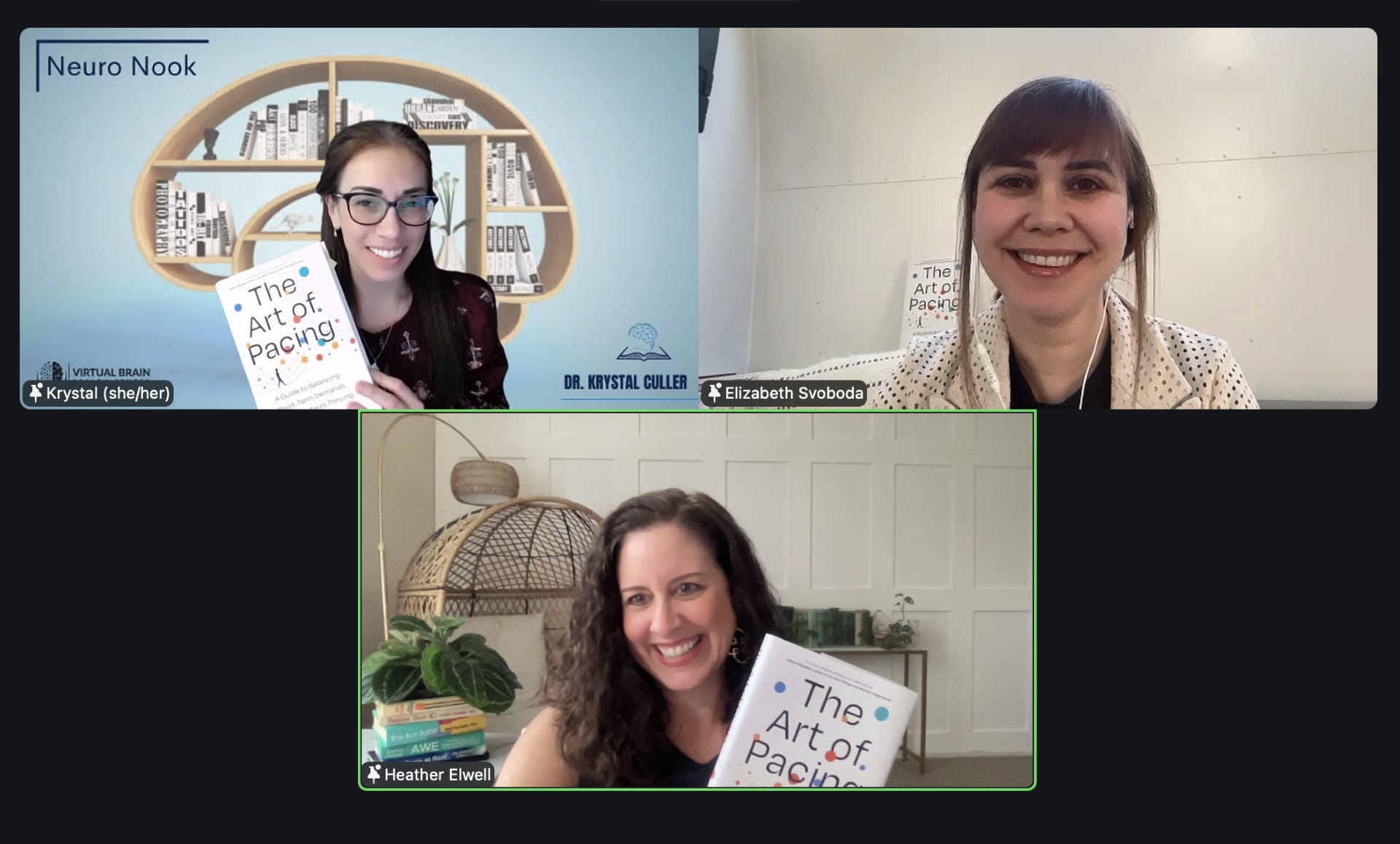
The full author conversation drops as a podcast episode on
Wednesday, October 21, but this recap includes something the podcast won’t:
the exclusive live Q&A our attendees had with Elizabeth,
plus a deep dive into the book’s science we didn’t have time to cover live!
Reader perks! Keep scrolling. 👇
What’s This Book❓Why Now❓
I first met this book as an early reader in a First Look Book Club, and confession time: I read a book about pacing in one sitting, curled up with my dogs on a summer night. The irony was not lost on me. 📚
But it landed at exactly the right moment. Summer has a way of speeding everything up, and I was craving stillness in the middle of all that hustle. The book also brought together so many topics our book club members have asked us to cover: circadian rhythms, stress management, burnout, and how to protect our energy for what matters.
And the timing for the club couldn’t have been better. As Heather pointed out, fall is when our calendars fill back up with new routines, new commitments, and new to-do lists. It’s the perfect season to pause and recalibrate.
It’s also the lead-up to the holiday season, when the hustle and bustle really kicks in. Need I say more about why it’s a great time to practice pacing?

💌 Words From The Author:
“…Deliberate pacing begins with an unsparing willingness to connect your daily decisions to their potential longer-term outcomes.”
💭 Reflection Questions for Real Life Integration (from the book)
When you were growing up, what messages did you hear about the relative importance of work and rest?
How did the culture around you shape your sense of how hard you ought to push yourself and what you ought to chase?
And when you pursued the goals you felt you should, rather than those that felt more organic and purposeful, did you notice shifts in your energy or motivation levels?
Consider how your existing ideas and pacing have shaped your life trajectory so far. If you felt compelled to go all out toward a goal, how did it go? Did pushing yourself to the edge energize or deplete you?
And if you’ve taken significant time off from work or other commitments, did that retreat leave you feeling bored and aimless, or restored and hungry to contribute?
Spend time developing some kind of touchstone that you can turn to when life goes to hell. Here are some questions to explore: What’s going to help you tolerate these feelings and thoughts, and then put your attention on what you truly care about, instead of being pulled down? In those dark moments, what can you bring to mind? (42)
When does focused progress feel more like moving with the current rather than swimming against it? As you consider this question, think about what times of day you typically have been most creative or energetic, or when you find it easiest to shut out distractions. (61)
Once your focused work is done, it’s critical to take a rest period commensurate with the effort you’ve put forth. What do you do after your workout is done for the day? (64)
In the aftermath of a tense or stressful moment, what options has modulation opened up for you that might not otherwise have existed? What future possibilities might extend from this fresh set of options? (81)

What You Should Know
What is pacing?
When we first announced this book, a few Nookers asked if pacing meant walking back and forth across a room. Not quite, though that image isn’t far off if you think about pacing as a spectrum and you glide along it.
Elizabeth defines pacing as being deliberate about how you manage your energy. That can happen on two timescales:
→ Day to day: how you spend your energy across a single day
→ The 30,000-foot view: where you want to be in a year or five years, and the pace that will get you there
Good pacing also means foresight: noticing trouble on the horizon and adjusting before you hit the wall. Her inspiration came from elite athletes, who are remarkably respectful of their physical and mental limits. They build in far more rest and recovery than most of us would ever expect.
🧠 Why it matters for your brain
The stakes of not pacing are real. In one study Elizabeth cites of more than 200 people treated for stress-related exhaustion, over 30% were still clinically exhausted seven years later, and only about 16% reported a full recovery.
She also reviews research linking chronic stress to changes in the brain. In some studies, people with more cortical thinning tended to be more psychologically brittle, with a stronger threat response and less capacity for higher-order thinking. (These findings show associations, not proof that stress alone causes these changes, but the pattern is worth paying attention to.) Survival mode can also create tunnel vision, which makes it harder to make the choices that would help us recover.
She also describes languishing: a state of stagnation that isn’t a crisis but feels like seeing your life through a foggy windshield.
The pacing continuum
One of the most useful ideas in the book is that pacing lives on a spectrum. Many of us ping-pong between extremes: going all out, crashing, withdrawing, then going all out again.
Skilled pacers master the middle. They stay productive and engaged without treating productivity as the goal in itself. Instead of quitting something that feels like too much, they might dial it back to 75% or half. Instead of saying yes to every new project, they talk honestly about the tradeoffs.
Pacing isn’t all or nothing. It’s a constant, fluid negotiation between expansion and contraction.
✍️ Start with your story
Before schedules and strategies, Elizabeth starts with purpose. She introduces a hero’s journey “re-storying” exercise, developed by researcher Ben Rogers, that asks you to imagine yourself as the protagonist on a quest:
→ What are you really after?
→ What obstacles stand in your way?
→ Who are your allies?
→ What legacy do you want to leave?
The point is to check whether your daily life lines up with what you say matters most. Without that clarity, even the best pacing tactics won’t move you in the right direction. (Elizabeth is sharing a link to the free exercise, which I’ll add here when it arrives.)
🎯 Pacing strategies for everyday life
Find your pulse points. We all have natural energy peaks and valleys. Research shows many people reach their attention peaks a few hours after waking, but your rhythm is your own. Save your most demanding work for your peak windows, and stop trying to push through the times when it feels like wading through mud.
Keep focus stretches manageable. Many people focus best for about one to two hours before their attention drifts.
Take smarter microbreaks. Even a few minutes can restore you, as long as the break is as different from your work as possible. Desk worker? Move your body or get outside. Research shows that scrolling your phone on a break often doesn’t restore you the way we hope. Feeling in control of how you spend the break matters too.
Match recovery to effort. Rest should be proportional to what you just gave. After an intense week or a big event, you may need several days to decompress. Athletes call this periodization: deliberately pairing hard training days with easier ones.
Learn from activity pacing. People living with conditions like chronic fatigue, lupus, or MS often practice “activity pacing”: regularly checking how much energy they have left and scaling plans up or down. It’s a skill all of us can borrow. As Elizabeth noted, another helpful term for pacing is simply “energy management.”
🌬️ Modulation: your built-in reset
Modulation is the ability to calm your stress response in the moment so you can make wiser choices. Elizabeth’s go-to tool is resonant breathing, which for most adults is around six breaths per minute. Slower breathing stimulates the vagus nerve, which helps lower blood pressure and promote calm.
Try a “long exhale”: take a full breath in, then let it out slowly, as if through a straw. Over time, she explains, this calm can become your new baseline. Modulation also supports metacognition, the ability to step back and evaluate your own thinking.
Note: the research on resonant breathing is still developing, but early findings are promising.
📵 Digital triage
The best digital pacers aren’t fully unplugged, at least not forever. Instead, they set clear terms of engagement: deciding how and why they want to show up online. Elizabeth describes this as charting a path through the noise that serves your goals, not the goals of apps designed to keep you scrolling.
A simple question helps: How do I actually want to spend my time?
🌊 Flourishing in flow
Flow is that state of total immersion where effort starts to feel effortless. For Elizabeth, it’s writing. For someone else, it might be fixing motorcycles or climbing a wall.
Research suggests flow needs two conditions:
→ The right challenge: hard enough to demand full focus, but not so hard you want to give up
→ Intrinsic motivation: something you find compelling for its own sake
Flow matters for pacing because it generates energy rather than draining it. It also quiets our self-consciousness, giving us a break from the constant performing that work and social media ask of us.
✍️ Neuro Nook Rx for Flow
from the Art of Pacing:
Set aside 60-90 minutes of uninterrupted time
for your chosen task at least one time per week.
Then, build this into a daily brain care practice
at the 60-90 minute interval.
🕯️Brief candles
This was the chapter we didn’t expect in a book about pacing, and it may be my favorite. A brief candle is a short but meaningful moment of full attention between two people. A five-minute conversation can restore someone’s belief in themselves and change the course of their life.
Brief candles break the usual math of time: more time in doesn’t always mean more impact out. They benefit the giver as well. Elizabeth shares research linking generativity in midlife (caring about guiding others, including the next generation) to better mental and cognitive health later in life.
She also describes taking in the good: deliberately savoring positive moments. Our brains tend to fixate on the negative as a survival strategy, so this practice helps strengthen the pathways that notice the good.
🤝 Healthy selfishness
Helpers, caregivers, and service-minded folks, this one’s for you. Healthy selfishness means protecting your own energy so you can keep showing up for what helps you and others flourish.
Rather than making snap judgments about generosity, Elizabeth suggests slowing down and asking:
→ How well does this commitment fit with the rest of my life?
→ How much do I actually enjoy it?
→ How meaningful is my contribution here?
→ Is someone else better equipped for this task?
“Good enough” is a pacing strategy
Elizabeth introduces selective mediocrity: doing “good enough” on most things and saving your full effort for what you’re truly passionate about. For recovering perfectionists like me (and Elizabeth, it turns out), this is a quietly radical permission slip.
“While pacing will always involve ongoing self-scrutiny, selective mediocrity offers a simple, subversive way to approach the decision-making that shapes daily rhythms.” (177)
📍Dropping off the map
Short breaks restore us, but longer breaks can transform us. One study found people’s health and life satisfaction on vacation didn’t peak until around day eight, which suggests a longer break may restore more than a long weekend. Feeling in control of your time off also predicts how good you’ll feel afterward.
〰️ Collective pacing
Pacing isn’t only personal. A sustainable team pace depends on more than hours worked. It takes trust, honesty, and real support when someone reaches their limits. It also takes ongoing attention to changing workloads and life circumstances.
And pacing is contagious. When we surround ourselves with people who reject the idea that grind equals virtue, it becomes easier to find the courage to set our own pace. Elizabeth also points to a growing slow and rest movement, from slow cities to online communities that give people permission to rest.
💡The Takeaway
Pacing is a practice of noticing and responding. Elizabeth borrows from how scientists work: try something, check how it’s going, then make the next good choice based on what you learn.
That’s where her anchor question comes in, which she learned from Olympian-turned-coach Amy Baldzell. When you feel overwhelmed, you don’t need to plan the whole day. You just need the next step, like hopping from stone to stone across a creek.
✍️ Brain Health Rx from The Art of Pacing:
Let one question guide your pace: What’s the wise choice here?
When you pause to reflect and tune into the wisdom of your body and brain, you can trust yourself to know what to do
to support your natural rhythm in real time.
🎤 EXCLUSIVE: The Live Q&A (Reader-Only Content!)
*This section was drafted with AI from our session recording and edited by me.
When creativity strikes, should you ride the wave or step away?
Elizabeth’s answer: ride it, within reason. She has written for two, three, even four hours at a stretch when the ideas are flowing. The key is that the wave will end on its own, and your body will tell you when. When your focus starts slipping, or you notice you’re hungry or need a break, that’s your cue. Until then, she says, ride that wave for all it’s worth.
What’s the relationship between multitasking and pacing?
Every time we switch tasks, it costs us a little energy, plus some lag time before we can fully focus on the new thing. Switch all day long, and you’ll likely end the day more exhausted. Elizabeth’s fix is batch processing: handle all your emails in one block, and stay in that mindset before moving on to deeper work. Fewer switch points mean more efficient use of your energy.
If you’re doing too much, do you drop the necessary goal or the meaningful one?
One Nooker asked about choosing between finishing a degree and volunteering at a senior living community. Elizabeth’s answer: it doesn’t have to be either/or. The beauty of pacing is that you can move along the whole spectrum. Maybe you take an extra semester with a lighter course load so your community work can stay in your life. Sometimes setting one thing fully aside is the right call, but first consider every way you could dial things back rather than seeing it as black and white.
As a recovering perfectionist and lifelong yes-person, I shared that I’ve had to learn this one slowly, after burning out more than once. Now I ask whether something brings me joy and aligns with my purpose, and I’m clearer about what I give freely versus what needs to be compensated. (Elizabeth is a recovering perfectionist too. You’re in good company.)
What’s the pacing style quiz all about?
Elizabeth created the What’s Your Pacing Style? quiz alongside the book. It walks you through a few everyday scenarios and gives you a pacing style:
→ Yo-Yo Pacer: swings between overcommitting, crashing, withdrawing, and overcommitting again (Elizabeth was one for years)
→ Hot Start Pacer: launches with big energy and enthusiasm, then peters out
→ Autopilot Pacer: going through the motions without much joy or spark
→ Marathon Pacer: a sustainable rhythm that knows when to push and when to pull back
Heather and I both got Marathon Pacer. I also took it a second time answering as my younger self, and got Yo-Yo Pacer. Lessons learned!
Elizabeth added a helpful reminder: your result can change from day to day. Under stress, we tend to revert to old habits, so the goal is to notice when that happens and reach for the tools we’ve learned instead.
Is there another word for pacing?
Pacing is a familiar term in chronic disease self-management communities, including for people living with conditions like MS. Elizabeth suggested “energy management” as a helpful alternative. People with energy limitations are modeling something all of us can learn from: knowing your energy quota for the day, then using it in the most fulfilling way, making progress toward your goals without careening into burnout.
🗨️ Final Takeaway Messages from the Hosts
Heather, Co-Host of the Neuro Nook:
💭 “Lifelong pacing involves setbacks, unexpected twists, and forays into the unknown…taken to its zenith, long-term pacing is a flexible, almost playful pursuit, one that makes room for stretches of expansion, contraction, and uncertainty. It’s in being willful to flail a bit— to venture into what feels like the belly of the whale— that you’ll find the stability you need to flourish.” (182)
Krystal, Host of the Neuro Nook:
💭 “As self-repair becomes socially contagious, it can also become a catalyst for meaningful collective repair. In a shortsighted, always-on culture, however, these repair attempts take no small amount of courage. While death-defying heroic acts cluster at one end of the bravery continuum, closer to the middle— and far more accessible— is everyday, necessary stubbornness: refusal to sacrifice our lives and principles on the altars of productivity, dominance, and self promotion… (185)
It takes courage… and it is easier to summon this kind of courage (or stubbornness as the case may be) when you surround yourself with people who are making off-course equilivalend ot a tethered to the one-upmanship, who reject the cultural norms that equate grind with virtue, and who create abundance that has nothing to do with their job title or account balance. These fellow travelers’ influence is contagious. When you witness others calling out lapses in integrity, you, too, will be more drawn to honest reckoning, recognizing when your bodily, mental, or ethical integrity has broken down and taking steps to restore it… “ (186)

🗓️ Upcoming Neuro Nook Meetings
Join me at the Virtual Brain Health Center with Brain Health Mentors for the upcoming Neuro Nook (Book Club) discussions, where we explore thought-provoking books that deepen our understanding of brain health and wellness.
Save the date for our future book club meeting from 12:00-1:00 PM EST on:
November 5, 2026— Live Author Appearance with Dr. Trevor Harley, Ph.D., author of 📘 Head in the Clouds: How the Weather Affects Our Minds & Mental Health
December 3, 2026— Live Author Appearance with Liam McClintock, author of
📘Fit Mind: 4 Steps To Lasting Bliss—Neuroscience and Meditation for Daily Life


In brain health & wellness,
- Krystal
A friendly reminder to learn more about pacing from the author on her Substack & website.👇
After reading this, you may find
“The essence of pacing in your own life:
noticing when frantic sprints or drawn-out stalls are consuming you—
not just physically but ethically and existentially—
and making bold adjustments that heal
and strengthen you on every level.” 🫶